Search for a car rental discount code before booking Lisbon Airport and you’ll find dozens of “voucher” sites listing codes with impressive-looking percentages off. Try applying most of them at checkout and nothing happens, or the code applies a discount so small it barely registers. Understanding which codes are genuinely live, and where they actually come from, saves the frustration of testing ten dead codes before finding one that works, or worse, giving up on a real saving because the first five attempts failed.
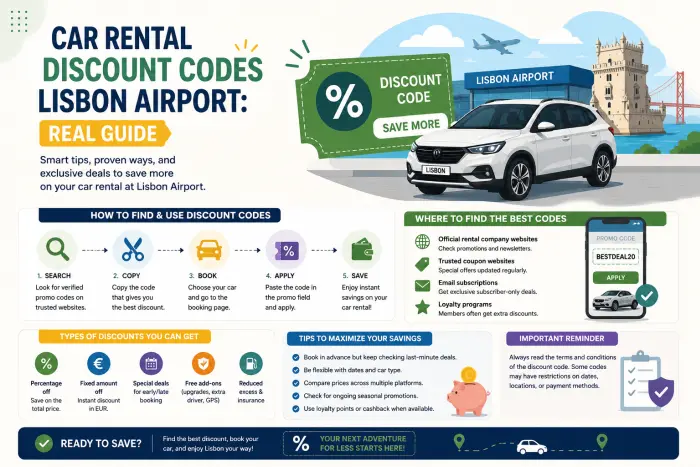
The discount codes that actually work almost always come from the supplier or platform directly, through a newsletter signup, a first-booking promo, or a seasonal sale, rather than from third-party voucher-listing sites, which are overwhelmingly expired or fabricated.
Why Most Voucher Sites Are a Waste of Time
Third-party coupon aggregator sites make money from traffic and affiliate clicks, not from the accuracy of the codes they list, which creates a structural incentive to keep old codes live on the page long after they’ve expired, since a page full of codes gets more clicks than an empty one. Many of these codes were valid once, for a specific short-lived campaign months or years ago, and simply never got removed. A smaller number are entirely fabricated, generated to look plausible and drive a click, with no functioning discount behind them at all. This isn’t unique to car rental; it’s the same pattern seen across most retail coupon-code searches, and it’s worth adjusting expectations accordingly before spending much time hunting.
Where Genuine Discounts Actually Come From
| Source | Reliability |
|---|---|
| Supplier or platform’s own newsletter signup | Genuine and current, typically a modest first-booking discount |
| Seasonal sales pages on the platform itself, like our Discovercars.com review covers | Genuine, time-limited, usually announced directly rather than via third-party code |
| Third-party voucher/coupon aggregator sites | Overwhelmingly expired or fabricated |
| Social media posts from the brand’s own official account | Often genuine if recent, worth checking post date |
| Random codes shared in forums or comment sections | Highly unreliable, frequently already used up if single-use |
How Much a Genuine Discount Actually Saves You
It’s worth calibrating expectations on size as well as legitimacy. A genuine newsletter or first-booking discount typically runs in the 5–10% range, occasionally higher during a specific seasonal promotion. This is a real saving worth capturing if it’s easy to get, but it’s not going to transform an expensive rental into a cheap one, and it’s rarely worth restructuring your entire booking strategy, like choosing a worse-located pickup point, purely to chase a modest percentage off.
The Newsletter Signup Trade-Off
Signing up for a supplier’s or platform’s newsletter specifically to capture a first-booking discount is a completely legitimate strategy, and often the single most reliable source of a genuine code, but it’s worth doing deliberately rather than as an afterthought. Use an email address you’re comfortable receiving ongoing marketing from, since that’s the actual exchange being made, and check whether the discount applies immediately or requires waiting for a follow-up email, which some suppliers do specifically to encourage a return visit rather than an immediate booking.
Comparing a Discount Code Against Simply Choosing a Cheaper Option
This is the detail that gets missed most often: a 10% discount code applied to an already expensive rate can still leave you paying more than a cheaper supplier or vehicle category without any code at all. Before hunting for a discount code, it’s worth first checking whether comparing prices across suppliers or simply reviewing cheap car rental options in Lisbon gets you further than chasing a percentage off a single quote. The code is worth applying once you’ve already landed on a competitive rate, not as a substitute for comparing in the first place.
Are Codes From Influencers or Affiliate Partners More Reliable?
Somewhat, though it depends entirely on the specific relationship. A code tied to a named creator or affiliate partnership with a brand is typically genuine for as long as that partnership runs, since the brand has a direct commercial reason to keep it functional and trackable. The risk is that these codes often expire quietly once a campaign ends without any public announcement, so a code from an old video or post can easily be dead despite looking current. Checking the date of the source and, where possible, testing the code before assuming it’ll apply at final checkout avoids a wasted step in the booking process.
Do Mobile Apps Offer Better Codes Than the Website?
Sometimes, and it’s worth checking specifically if you haven’t already. A number of suppliers and platforms run app-exclusive promotions as a way of encouraging downloads and repeat use, offering a slightly better rate or an extra small discount that isn’t available through the same booking flow on a desktop browser. This isn’t universal, and the difference is usually modest rather than dramatic, but for a traveller who’s already going to use the app for booking confirmations and pickup details anyway, checking the app’s own promotions page before finalising a booking made on desktop costs nothing and occasionally turns up a genuine saving the website version doesn’t show.
Seasonal Sales Are More Reliable Than Codes
Rather than hunting for a specific code, it’s often more productive to simply watch for a supplier’s or platform’s own announced seasonal sale periods, which tend to be more transparent and easier to verify than a scattered code search. These sales are usually applied automatically to eligible bookings during the promotional window rather than requiring a code to be entered at all, which removes the entire question of whether a specific code is still live. Checking a platform’s own promotions or deals page directly, rather than a third-party aggregator, is the more reliable way to catch one of these windows.
💸 Don’t Overpay at the Airport
Compare real-time rental deals with no hidden fees or credit card needed.
Stacking Codes: Does It Ever Work?
Rarely, and it’s not worth spending much time attempting it. Most booking systems, whether on the supplier’s own site or through an aggregator, are built to accept a single promotional code per transaction, and attempting to combine two typically just results in the second one being silently ignored or rejected outright. If you do find yourself with two potentially valid codes, it’s more useful to test each individually and use whichever produces the larger discount, rather than assuming they’ll combine.
📋 Discount Code Checklist for Lisbon Airport Car Rental
- Check the supplier’s or platform’s own site and newsletter before searching third-party voucher pages
- Treat any code from a coupon-aggregator site as likely expired until proven otherwise at checkout
- Compare the discounted price against a cheaper supplier or category before assuming the code makes this the best deal
- Sign up for a newsletter deliberately if a first-booking discount is worth the ongoing marketing emails to you
- Don’t expect codes to stack — test each one individually if you have more than one
For the fuller Lisbon Airport rental process, see our complete guide.
Frequently Asked Questions
Do the car rental discount codes listed on voucher websites actually work at Lisbon Airport? Rarely. Most third-party coupon-aggregator codes are expired or fabricated, since these sites profit from clicks rather than the accuracy of what they list.
Where can I find a genuine discount code for a Lisbon Airport car rental? The supplier’s or platform’s own newsletter signup, official social media accounts, and seasonal sale announcements are the most reliable sources, rather than third-party voucher sites.
How much can I realistically save with a car rental discount code? Typically 5–10% for a genuine first-booking or newsletter code, occasionally more during a specific seasonal promotion. It’s a real saving but not usually large enough to outweigh choosing a cheaper supplier outright.
Can I use two discount codes on the same Lisbon Airport car rental booking? Almost never. Most booking systems accept only one promotional code per transaction, so test codes individually rather than assuming they’ll combine for a bigger discount.
Is it worth signing up for a newsletter just to get a discount code? It can be, if you’re comfortable with the ongoing marketing emails that come with it. It’s typically the single most reliable source of a genuine first-booking discount.
Do mobile apps offer better car rental discounts than booking on a website? Sometimes. Some suppliers and platforms run app-exclusive promotions to encourage downloads, though the difference is usually modest. Checking the app’s promotions page before booking on desktop is worth the small effort.
Are seasonal sales more reliable than hunting for a discount code? Generally yes. Announced seasonal sales are usually applied automatically during the promotional window and are easier to verify than a scattered code search across third-party sites.
For the broader decision of where to actually book once you’ve found a fair rate, see our Discovercars vs booking direct comparison, and if timing your booking matters more than a specific code, best time to book a Lisbon Airport car rental covers the price curve worth planning around instead. If ongoing club or membership discounts are more your situation than one-off codes, see membership discount car rental in Portugal.