Pull up three quotes for the same vehicle category at Lisbon Airport and the headline prices can look deceptively close, or deceptively far apart, without actually telling you which one costs less by the time you drive away. The number shown at the top of a search result is built differently by different suppliers and platforms, and comparing those numbers directly, without checking what’s included underneath, is the single most common way travellers end up paying more than they expected.
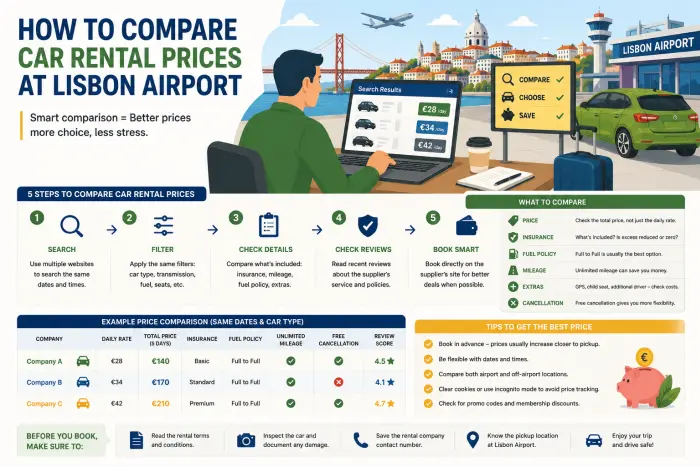
A fair comparison means checking the total price including mandatory fees and taxes, the excess and insurance included by default, the fuel policy, and the mileage allowance, not just the headline daily rate. Two quotes that look identical on price can differ by a meaningful amount once these are accounted for.
Why the Headline Price Alone Is Misleading
Rental pricing systems display a base rate prominently, but what’s bundled into or excluded from that number varies by supplier. Some quotes include mandatory local taxes and airport surcharges in the headline figure; others add them only at the final checkout step, making an initially cheaper-looking quote catch up or overtake a competitor once the full total is revealed. This isn’t necessarily deceptive practice so much as inconsistent industry convention, but it means the number that first catches your eye is rarely the number that determines which quote is actually better.
What to Actually Check Before Comparing Two Quotes
| Comparison Factor | Why It Matters |
|---|---|
| Total price including taxes and mandatory fees | The real cost, not the attention-grabbing headline figure |
| Excess/deposit amount included by default | A lower headline price sometimes comes with a much higher default excess |
| Fuel policy | Full-to-full vs prepaid fuel options change effective cost meaningfully |
| Mileage allowance | Unlimited vs capped mileage matters for anything beyond short local driving |
| Cancellation terms | A slightly higher price with free cancellation can be worth more than a locked-in cheaper rate |
The Excess Trap: Cheap Headline Price, Expensive Default Coverage
This is one of the most consistent ways an apparently cheaper quote turns out to be the worse deal. A supplier offering a noticeably lower daily rate sometimes compensates by defaulting to a much higher excess, the amount you’re liable for if the car is damaged, than a competitor’s higher-priced quote that includes a lower default excess. Comparing two prices without checking the excess figure means comparing two genuinely different products dressed up to look like the same one. Our guide on Portugal car rental insurance explained covers how to read and compare excess and coverage terms specifically.
Fuel Policy Can Quietly Shift the Real Cost
A full-to-full fuel policy, where you collect and return the car with a full tank, is generally the fairest and most predictable for the renter. A prepaid fuel option, where you pay for a full tank upfront regardless of how much you actually use, can make a quote look competitively priced while effectively charging for fuel you may not use if your driving is lighter than a full tank’s worth. Checking the specific fuel policy on each quote, not just assuming they’re equivalent, is worth the extra minute when two prices are otherwise close.
Comparing Across Aggregators and Direct Sites at Once
Getting a genuinely fair comparison usually means checking more than one source, since no single platform reliably shows every supplier’s best available rate for every date. Running the same vehicle category and dates through an aggregator like Discovercars alongside a direct check on one or two preferred suppliers’ own sites gives a more complete picture than relying on a single source, since pricing structures and included fees can differ meaningfully between the same supplier’s aggregator listing and their own direct booking flow. Our comparison of Discovercars vs booking direct covers that specific trade-off in more depth.
Does When You Compare Prices Matter as Much as How?
Somewhat, and it’s worth being aware of alongside the mechanics of comparing quotes properly. Prices for the same vehicle and dates can shift day to day as suppliers adjust based on remaining inventory, which means a comparison run a week apart isn’t strictly comparing the same underlying offer even if the vehicle category and dates are identical. This doesn’t undermine the value of comparing carefully, but it’s worth doing your full comparison, checking multiple sources and all the factors above, within a fairly short window rather than spreading it out over days and assuming earlier findings still hold by the time you’re ready to book.
Does the Vehicle Category Actually Match Between Quotes?
A subtler distortion worth checking: “compact” or “economy” labels aren’t perfectly standardised across suppliers, and two quotes both labelled the same category can represent genuinely different vehicles in terms of size, features, or age. Before concluding one quote is cheaper for the “same” car, it’s worth checking the specific example vehicle listed on each quote, since a lower price sometimes reflects a smaller or older vehicle within a loosely defined category rather than a genuine discount on an equivalent car. This is especially worth checking for less standardised categories like SUVs or 7-seaters, where the range of vehicles a supplier might allocate under the same label is wider than for a straightforward economy hatchback.
💸 Don’t Overpay at the Airport
Compare real-time rental deals with no hidden fees or credit card needed.
Currency Display Can Distort a Comparison Too
If you’re comparing quotes shown in different currencies, whether because you’re browsing from outside the eurozone or comparing a platform that displays prices in your home currency against a supplier’s own site showing euros, it’s worth converting both to the same currency using a current exchange rate before assuming you’re comparing like for like. A platform’s displayed conversion isn’t always using the same rate or timing as your own card issuer will apply at the actual charge, which can introduce a small but real discrepancy that complicates an otherwise straightforward price comparison, particularly on a longer rental where the total amount is larger.
Building a Simple Comparison Habit
Rather than treating every booking as a fresh research project, it’s worth developing a consistent short checklist to run through each time: total price with taxes, default excess, fuel policy, mileage cap, and cancellation terms, in that order, for each quote under serious consideration. This takes a few extra minutes over simply picking the lowest headline number, but it’s the difference between comparing genuinely equivalent options and comparing five different products that happen to share a similar-looking price tag.
Price Comparison Checklist for Lisbon Airport Car Rental
- Compare total price including taxes and mandatory fees, not the headline daily rate alone
- Check the default excess amount on each quote before assuming a cheaper price is a better deal
- Confirm the fuel policy specifically, since a prepaid option can hide extra cost in an otherwise competitive price
- Verify the mileage allowance if your trip involves real distance beyond the city
- Check both an aggregator and a direct supplier site for the same dates before deciding
See our complete Lisbon Airport rental guide for the logistics side beyond price.
Frequently Asked Questions
Why do two Lisbon Airport car rental quotes with a similar headline price sometimes cost very differently in total? Because taxes, mandatory fees, default excess, and fuel policy are bundled differently between suppliers, so the headline number alone rarely reflects the true total cost you’ll actually pay at pickup and return.
What’s the most commonly overlooked factor when comparing car rental prices? The default excess amount. A cheaper headline price sometimes comes with a much higher liability if the car is damaged, making it a worse deal overall than a slightly pricier quote with better included coverage.
Should I compare prices on an aggregator or directly with suppliers? Both. No single platform reliably shows every supplier’s best rate for every date, so checking an aggregator alongside one or two direct supplier sites gives a more complete picture.
Does it matter how many days apart I compare different quotes? Yes, somewhat. Prices shift daily based on remaining inventory, so it’s best to complete a full comparison within a short window rather than spreading it across several days and assuming earlier findings still apply.
Does “economy” or “compact” mean the same vehicle across every supplier? Not necessarily. These category labels aren’t fully standardised, so it’s worth checking the specific example vehicle on each quote before assuming two similarly labelled options are truly equivalent.
Should I worry about currency when comparing car rental prices from different sources? Yes, if the quotes are shown in different currencies. Converting both to the same currency at a current exchange rate avoids a comparison distorted by inconsistent conversion timing or rates between platforms.
For general budget strategies beyond price comparison mechanics, cheap car rental in Lisbon is a useful complementary read. To see which suppliers are generally well-regarded beyond price alone, our best car rental companies at Lisbon Airport roundup and Discovercars.com review are good starting points.