The Azores’ inter-island ferries technically do carry vehicles on most routes, which leads many travelers planning a multi-island trip to assume they can simply drive their rental car onto the ferry and continue exploring the next island with the same vehicle throughout their trip. In practice, this usually isn’t how it works, since the real constraint is your rental agreement, not the ferry itself, and most rental companies specifically prohibit taking their vehicle to another island under any circumstances.
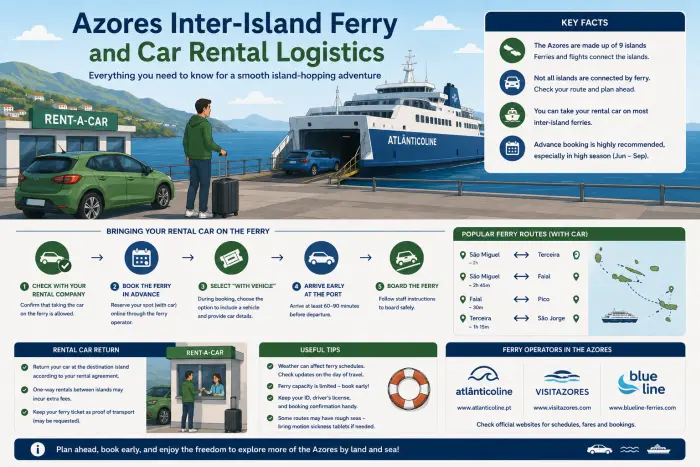
The widely recommended approach, confirmed across multiple independent traveler guides, is to return your rental car on the island where you picked it up, take the ferry or flight to your next island as a passenger, and rent a separate car upon arrival. This is generally simpler and more reliable than trying to arrange cross-island vehicle transport, which most suppliers don’t offer regardless of what the ferry itself technically permits.
Why the Ferry Allowing Vehicles Doesn’t Mean Your Rental Can Cross
This is the specific point of confusion worth clearing up directly. Atlânticoline, the sole ferry operator connecting Azores islands within the same group, does accept vehicles on most of its routes, genuinely transporting cars across water. What it doesn’t control is your specific rental company’s own terms, and the large majority of rental agreements restrict the vehicle to the island it was rented on, regardless of whether the ferry itself would physically accommodate it. Some suppliers may permit this for closely adjacent islands with an advance request, but this is the exception rather than a standard, expected option.
Which Islands Actually Connect by Ferry
| Island Group | Ferry Connection |
|---|---|
| Central group (Faial, Pico, São Jorge, Terceira, Graciosa) | Faial-Pico runs year-round and frequently; other central routes mostly seasonal (summer) |
| Western group (Flores, Corvo) | Year-round service, weather permitting |
| Eastern group (São Miguel, Santa Maria) | No ferry connection currently; flights only |
| Between different island groups | No ferry connection at all; flights are the only option |
The Practical Alternative: Rent Fresh on Each Island
Rather than fighting against rental company restrictions, the standard and widely recommended practice is straightforward: return your car at the end of your stay on one island, travel to the next island by ferry or flight as a passenger, and pick up a new rental at your next destination. This is genuinely simpler logistically, avoids any risk of a supplier refusing your vehicle at the ferry terminal, and each island’s own rental options are typically well set up for exactly this kind of single-island rental pattern, since it’s how most visitors actually travel through the archipelago.
Flights vs Ferries: When Each Makes Sense
For islands within the same group, particularly Faial and Pico specifically, the short and frequent ferry crossing is often the more convenient and scenic choice over booking a flight for what’s genuinely a short hop. For inter-group travel, São Miguel to the central group, for instance, or reaching the eastern group at all, flying via SATA/Azores Airlines is the only option, since no ferry service exists between island groups under any circumstance. Our guide on car rental across Portugal’s islands covers the broader picture of renting across multiple Azores or Madeira locations, useful context alongside this specific ferry-versus-flight decision.
Planning Around Weather Disruption
Atlantic weather can and does disrupt both ferry and flight schedules, most commonly between November and March, a pattern worth building into your itinerary planning rather than treating as an unlikely edge case. A commonly recommended practical tip: structure your itinerary so the island you’re departing the Azores from entirely, the one connecting to your flight home, is the last one you visit and has already been fully explored by the time you arrive there. This way, a weather-related delay affects only your final, already-completed stop rather than cutting short sightseeing you hadn’t gotten to yet.
Booking Your Ferry Ticket in Advance
If you’re taking the ferry as a passenger, without a vehicle, booking is generally more flexible and can often be done closer to your travel date, except during peak July and August demand. If you were considering bringing a vehicle across, worth confirming directly with Atlânticoline given the more limited vehicle space, booking as early as possible is essential specifically for that scenario, though as covered above, this is rarely the practical route most travelers actually take given rental company restrictions.
São Miguel: Your Likely Starting Point
Most international flights into the Azores land at Ponta Delgada on São Miguel, making it the natural starting point for most multi-island itineraries even though it has no ferry connection to any other island. Our guide on car rental at Ponta Delgada Airport covers the specifics of that starting-point booking, worth reading alongside this ferry logistics guide since your São Miguel rental will need to be returned there before flying onward to any other island group, rather than carried with you. The same goes for Santa Maria, the other island of the eastern group, which you reach by a short flight from Ponta Delgada rather than by ferry, and our guide to car rental at Santa Maria Airport covers renting there.
💸 Don’t Overpay at the Airport
Compare real-time rental deals with no hidden fees or credit card needed.
The Faial-Pico Crossing: Worth Knowing Separately
Given how frequently it comes up in Azores trip planning specifically, the Faial-Pico ferry deserves its own mention: a short, scenic, and genuinely reliable year-round crossing between two of the central group’s most popular islands, distinct from the more limited, seasonal service connecting the rest of the central group. If your itinerary focuses specifically on these two islands, this particular crossing is considerably more dependable to plan around than the broader seasonal ferry network covering the rest of the archipelago. On the Faial side, our guide to car rental at Horta Airport explains who has desks at the terminal and when they close, and our page on renting a car at Pico Airport covers the other end of the crossing.
Cost Comparison: Ferry vs Flight for Inter-Island Travel
Worth weighing directly rather than defaulting to whichever option comes to mind first, since the cost gap between the two can be substantial. A short inter-island flight can run considerably more than the equivalent ferry crossing for a comparable route, sometimes several times the cost for a journey of only 30-45 minutes either way. For islands connected by both options, particularly within the central group, the ferry is generally the more budget-friendly choice when your schedule allows for its typically slower but scenic crossing, while flying remains the only option at all for inter-group connections regardless of cost.
Flores and Corvo: The Remote Western Group Exception
Worth a specific mention since it’s the smallest and most remote pairing in the archipelago: Flores and Corvo, the western group, maintain year-round ferry service weather permitting, despite being considerably more isolated than the central group islands. This makes them a genuine option for island-hopping even outside peak summer season, unlike much of the central group’s more seasonally limited service, though the same rental car restrictions and weather-related delay risk apply here as anywhere else in the archipelago.
Azores Inter-Island Logistics Checklist
- Confirm your specific rental company’s policy before assuming your car can cross to another island
- Default to returning your car and renting fresh at each new island, the standard and simplest approach
- Check which islands are actually in the same group before assuming a ferry connection exists
- Use flights for any inter-group travel, since no ferry service connects different island groups
- Plan your departure island last in your itinerary to minimize the impact of a weather-related delay
Frequently Asked Questions
Can I take my Azores rental car on the ferry to another island? Usually not. While the ferry itself often accepts vehicles, most rental agreements restrict the car to the island it was rented on, making this the exception rather than a standard option.
What’s the standard way to explore multiple Azores islands with a rental car? Return your car on each island before departing, then rent a separate car upon arrival at your next island, rather than trying to transport the same vehicle across.
Do ferries connect all the Azores islands? No. Ferries only connect islands within the same group, never between groups, and some routes are seasonal. Flights via SATA/Azores Airlines are required for inter-group travel.
Why should I visit my departure island last in an Azores itinerary? Atlantic weather can delay ferries and flights, most commonly November through March, so finishing your sightseeing on your final island before any potential delay protects the rest of your trip.
Do I need to return my São Miguel rental car before flying to another island? Yes. São Miguel has no ferry connection to any other island, and rental cars don’t travel between islands regardless of transport method, so returning it before departing is standard practice.
Is the Faial-Pico ferry more reliable than other central group routes? Yes, it runs year-round and frequently, making it considerably more dependable to plan around than the broader seasonal ferry network covering the rest of the central group islands.
To compare specific island airport pickup options, our Madeira Airport car rental guide covers that separate archipelago’s own logistics.