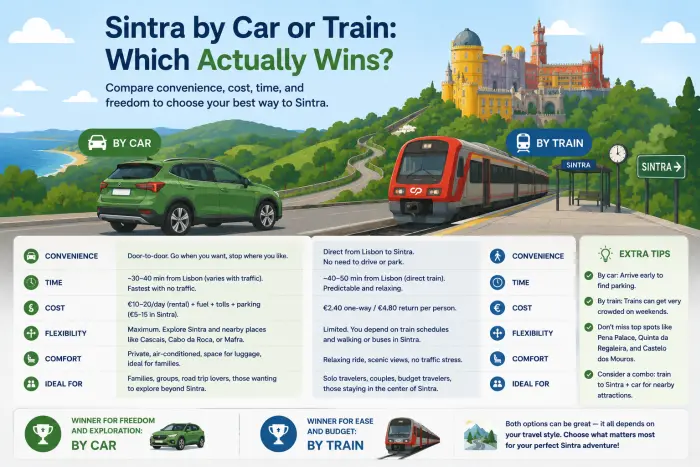
The standard Sintra advice — take the train, skip the parking headache — assumes a solo traveler or a couple visiting at the busiest time of year. Change either variable, group size or season, and the math shifts more than most guides let on. This isn’t another rundown of whether the roads to Pena Palace are congested; it’s a look at the two factors that actually flip the car-versus-train decision for a meaningful share of visitors: how many people you’re traveling with, and when you’re going.
Where the Per-Person Train Fare Stops Being the Deciding Factor
A round-trip train ticket from Rossio runs a few euros per person, which is genuinely the cheapest way for one or two people to reach Sintra. But that price scales linearly — four tickets cost four times one — while a rental car’s cost for the day stays essentially fixed regardless of whether one person or five is in it. The crossover point isn’t exotic: a family of four or a group of three friends splitting a compact rental for the day frequently lands at or below the combined train fare once the math is actually run, not just assumed to favor the train by default.
| Group size | Train (round trip, per person) | Rental car for the day | Cheaper option |
|---|---|---|---|
| 1 traveler | Lowest total cost | Full daily rate falls on one person | Train |
| 2 travelers | Still competitive | Splits the daily rate two ways | Close — often train |
| 3-4 travelers | Fares add up per person | Same daily rate, split further | Often comparable or cheaper by car |
| 5+ travelers | Highest total train cost | May need a larger vehicle | Usually cheaper by car |
The Piece the Train Fare Doesn’t Include
Group train travel to Sintra rarely ends at the ticket price. Once you’re there, getting between the station, the historic centre, and the hilltop palaces typically means the local shuttle bus, a taxi, or a tuk-tuk for a group that doesn’t want to walk the steep approach roads — and those costs also multiply per person the same way the train fare does. A group of four paying for train tickets and then four shuttle-bus fares in each direction is paying for mobility twice, in a way a car parked near the palace entrance simply doesn’t require.
Why Off-Season Changes the Calculation Again
Sintra’s parking difficulty is a summer problem more than a year-round one. Outside July and August, particularly on weekdays, the same car parks that fill by mid-morning in peak season routinely have space well past 10am, and the palace approach roads carry a fraction of the tour-bus traffic that makes June-through-August driving genuinely stressful. Visiting in November or February doesn’t just mean thinner crowds at the palaces themselves — it removes most of the reason the “don’t drive to Sintra” advice exists in the first place.
Shoulder Season as the Sweet Spot
Late spring and early autumn split the difference: crowds are lighter than peak summer but not as thin as deep winter, and this is often where the group-size math and the season math reinforce each other most usefully. A group of four visiting in April or October gets both the cost advantage of splitting a rental and a meaningfully easier parking situation than the same trip in August — the two variables in this piece compounding rather than working against each other.
💸 Don’t Overpay at the Airport
Compare real-time rental deals with no hidden fees or credit card needed.
When the Standard Advice Still Wins
None of this overturns the basic rule for a solo traveler visiting at peak season — the train remains the simpler, cheaper, lower-stress choice in that specific case, and nothing about group economics changes that for a party of one. The group-size and season math in this piece matters specifically for the visitors the generic advice doesn’t quite fit: families, groups of three or more, and anyone with the flexibility to pick a quieter month.
Frequently Asked Questions
At what group size does driving to Sintra become cheaper than the train? Somewhere around three to four people, once the rental’s fixed daily cost is split and compared against that many individual round-trip train fares plus local transport at the Sintra end.
Does visiting outside summer really make driving easier? Yes — parking availability and traffic both ease substantially outside July and August, particularly on weekdays, which removes most of the friction that makes peak-season driving to Sintra difficult.
Is a taxi or tuk-tuk from the train station included in the train ticket price? No, and this is the cost visitors most often forget to add when comparing train and car options for a group — local transport at the Sintra end is a separate expense either way, though it applies more heavily to train-plus-shuttle trips than to arriving by car.
Is shoulder season a good compromise if I can’t avoid summer entirely? Late spring and early autumn generally offer noticeably easier parking and lighter crowds than peak summer, without the thinnest crowds of deep winter — a reasonable middle ground if your travel dates have some flexibility.
Does this change the advice for a solo traveler? Not really — for one person, especially in peak season, the train remains the simpler and cheaper option. The group-size and season factors here matter most for larger parties and off-peak travelers specifically.