Ask ten people whether you need a car in Lisbon and you’ll get ten different answers — mostly because they’re each answering a slightly different question. If you mean “do I need a car to get around the city itself,” the honest answer is almost always no. If you mean “do I need a car to actually see Portugal,” the answer flips just as fast. This guide is for sorting out which situation you’re actually in, and what to do about it either way.
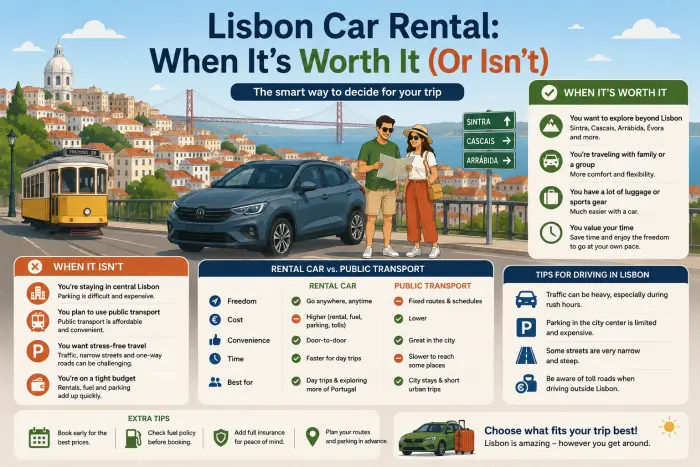
Do you even need a car in Lisbon?
Lisbon is compact, walkable, and built on seven hills that make driving genuinely unpleasant in the historic center. Alfama, Bairro Alto, and parts of Baixa have streets narrow enough that two cars can’t pass, cobblestones that rattle a rental’s suspension, and one-way systems that turn a five-minute drive into twenty. The metro, trams, and Uber/Bolt cover the city itself better than a car ever could, and parking in the center runs €20–35 a day in a garage — assuming you can find one with space.
Where a car earns its keep is everything outside the city. Sintra’s palaces, Cascais’s coastline, the beaches west of Lisbon, Arrábida, Évora, and the wider Alentejo are all far easier — and often cheaper for two or more people — by car than by cobbling together trains and buses. If your trip is Lisbon-only, skip the rental entirely. If it includes day trips or a longer road trip, a car becomes genuinely useful — just not for the days you’re staying put in the city.
When to actually pick up the car
The single most common mistake visitors make is renting for their entire Lisbon stay instead of picking the car up on the day they actually need it. If you’re spending three or four days in the city before heading out to the Algarve or the Douro, there’s no reason to pay for parking and insurance on a car that sits in a garage while you walk to dinner. Stay car-free for the city portion, take the metro or a tram to get around, and collect the rental on the morning you’re leaving.
This matters more than it sounds like it should, because Lisbon parking isn’t just expensive — it’s also a genuine source of stress. Older neighborhoods weren’t built with cars in mind, hotels rarely have dedicated parking, and street parking is metered and zone-based through the city’s EMEL system, with rules that shift depending on which color zone you’re in. None of that is a problem once you’re out of the city on open roads; all of it is a problem while you’re trying to enjoy Alfama for an afternoon.
💸 Don’t Overpay at the Airport
Compare real-time rental deals with no hidden fees or credit card needed.
Airport vs. city center pickup
For most travelers flying in, Lisbon Airport (Humberto Delgado) is the simplest pickup point — it’s about 7km from the center, all the major companies operate there, and if you’re driving straight out toward the Algarve or the interior, there’s no reason to add a detour into the city first. The tradeoff is that airport pickups sometimes carry a small surcharge, and desks can get busy during peak summer arrivals.
City-center pickup makes more sense if you’re already spending a few days in Lisbon before your road trip starts, since it lets you avoid parking a rental car during that stretch and collect it exactly when you need it — often from an office near Marquês de Pombal, which sits close to the main motorways out of the city. Rates downtown can run slightly lower than airport desks too, since you’re not paying the airport concession fee baked into the daily rate. For a full side-by-side comparison of timing, pricing, and which locations tend to have better availability, see our guide on Lisbon Airport vs. city car rental.
What kind of car actually makes sense
Lisbon’s hills, narrow lanes, and cobblestones reward a small, manual, easy-to-park car far more than they reward a big SUV. A compact hatchback handles the historic center’s tight corners and steep hill-starts without drama, and it’s cheaper to rent and easier to fit into the small garages that do exist. Automatics are available but cost noticeably more and can sell out first in high season, so book early if you need one. If you’re heading into the Algarve, Alentejo, or Douro afterward, the same compact car is usually fine for the motorways too — you only need something larger if you’re traveling as a family with serious luggage, or heading somewhere genuinely rural.
| City-only stay | Road trip beyond Lisbon | |
|---|---|---|
| Rent a car? | No — walk, metro, tram, Uber/Bolt | Yes |
| Best pickup point | Skip it | Airport (flying straight out) or city (staying first) |
| Best car size | N/A | Compact/manual for most routes |
| Parking cost | €20–35/day in center | Not a factor once you’re on the road |
| Biggest risk | Wasted rental days sitting in a garage | Picking up too early and paying for unused city days |
Driving out of Lisbon
Once you’re clear of the historic center, Lisbon driving becomes straightforward — well-signed motorways, tolls handled through the Via Verde electronic system, and quick access to Sintra, Cascais, and the A2 south toward the Algarve. The two bridges out of the city, 25 de Abril and Vasco da Gama, both get congested during weekday rush hours (roughly 7:30–10:00 and 17:00–19:30), so if you have flexibility, timing your departure around those windows saves real time. For the tolls themselves, our Via Verde toll transponder guide covers how the system works and what it costs on a typical rental.
What it actually costs
Lisbon car rental prices swing hard with season. Off-season (November–February), a small manual car can run as low as €12–20 a day from a budget or local operator; peak summer (July–August) pushes the same car to €35–50 a day, and automatics run 30–50% above that. Airport desks typically add a modest surcharge over city-center rates for the convenience of on-site pickup, though the gap has narrowed as more companies operate directly in the Terminal 1 rental center rather than requiring a shuttle.
Booking two to three weeks ahead — earlier for July, August, or Easter week — usually locks in meaningfully better rates than a last-minute booking, and it guarantees availability for automatics or larger vehicles, which do sell out in peak season. If cost is the deciding factor between renting and not, run the numbers against a few days of trains to Sintra and Cascais plus taxis or Uber/Bolt for the rest — for a solo traveler or couple staying only in Lisbon, public transport is almost always cheaper once you add up rental, insurance, fuel, and parking.
The bottom line
Renting a car in Lisbon is the right call for exactly one kind of trip: one that leaves the city. If you’re staying put, public transport and your own feet will get you everywhere worth going, and a parked rental just becomes an expensive inconvenience. If Sintra, Cascais, the Algarve, or the Alentejo are on your itinerary, book the car — just time the pickup to the day you actually start driving, choose a small car for the city’s tight streets, and decide upfront whether airport or downtown pickup fits your route better.