Travellers used to renting cars in North America or parts of Asia, where automatic transmission is the default, are often surprised to discover that manual is still the standard configuration across most of Portugal’s rental fleet. This isn’t a minor detail buried in the booking flow, it directly affects price, availability, and whether you can actually drive the car you’ve reserved, making it worth understanding before you book rather than after arriving at the counter.
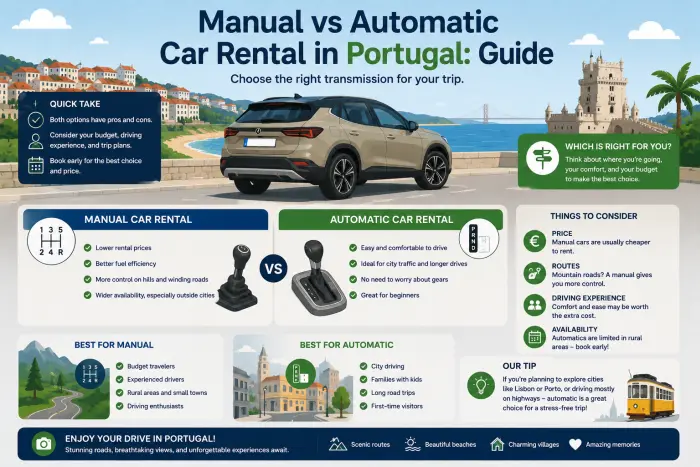
The one rule: if you can’t confidently drive a manual transmission, book automatic explicitly and early, since it’s a smaller share of the fleet with its own surcharge and tighter availability, particularly in peak season. Don’t assume automatic is the default the way it might be in your home country.
Why Manual Still Dominates in Portugal
Manual transmission remains the standard across most of Europe, including Portugal, for reasons rooted in decades of vehicle manufacturing and driver training conventions that differ from markets like the US where automatic became the default much earlier. Rental fleets reflect the broader domestic car market they’re drawn from, and since most Portuguese drivers learn and drive manual, that’s what dominates the used and fleet vehicle supply rental companies purchase from. This isn’t changing quickly, so it’s a safe assumption to plan around rather than something likely to shift meaningfully within the near future.
Availability and Price Comparison
| Factor | Manual | Automatic |
|---|---|---|
| Fleet availability | Standard, widely available across nearly every category | Smaller share of the fleet, tighter in popular categories |
| Typical price | Base rate for the category | Often a daily surcharge, sometimes 10-20% over manual |
| Booking lead time needed | Minimal for most dates | Longer lead time recommended, especially peak season |
| Vehicle category range | Full range from economy to premium | More limited selection, particularly at the economy end |
Do You Actually Know How to Drive a Manual?
This sounds like an obvious question, but it’s worth being genuinely honest about rather than assuming a technically-true “I learned once” is sufficient for driving unfamiliar roads in a foreign country. Someone who learned manual years ago but hasn’t driven one regularly since is in a meaningfully different position than someone who drives manual daily, particularly for Lisbon’s hillier streets, where stalling on an incline in traffic is a realistic and stressful scenario for a rusty manual driver. If there’s genuine uncertainty about your manual skills, the automatic surcharge is cheap insurance against a stressful first day of driving in an unfamiliar country.
Booking Automatic: What to Expect
If automatic is a firm requirement, treating it as a priority at booking rather than an afterthought pays off. Selecting the automatic filter early in your search, rather than browsing broadly and hoping to switch later, gives a more accurate picture of actual availability and price for your specific dates. During peak summer months, automatic vehicles in popular categories can sell out well before the equivalent manual inventory does, since the smaller automatic fleet share means less headroom before a specific date is fully booked. Our guide on best time to book a Lisbon Airport car rental covers general booking-timing strategy that applies with extra force to automatic bookings specifically.
Does Vehicle Category Affect Automatic Availability?
Yes, meaningfully. Automatic transmission tends to be more consistently available in higher vehicle categories, SUVs and premium sedans in particular, than in the cheapest economy category, where manual is often the only or overwhelmingly dominant option. If automatic is essential and budget allows some flexibility, being open to a slightly higher vehicle category can meaningfully improve your odds of finding automatic availability for your specific dates, compared with insisting on the cheapest category and automatic transmission simultaneously.
Does This Differ Between Major Brands and Local Operators?
Somewhat. International brands with larger, more diverse fleets generally offer a wider automatic selection across more vehicle categories than smaller local Portuguese operators, whose fleets tend to skew even more heavily manual, reflecting the domestic market they draw from most directly. If automatic is a firm requirement and you’re weighing a smaller local operator against a major brand for cost reasons, it’s worth confirming automatic availability specifically before assuming the smaller operator can accommodate it as readily as a larger international fleet.
For Drivers Who’ve Never Driven Manual at All
This is a different situation entirely from a rusty-but-experienced manual driver, and worth being explicit about. If you’ve genuinely never operated a manual transmission, learning for the first time on an unfamiliar rental car, in a foreign country, on unfamiliar roads, is not a reasonable place to start. This isn’t a matter of confidence or nerve, it’s a straightforward safety and practicality issue, and automatic should be treated as a non-negotiable requirement rather than a preference in this specific situation, regardless of the surcharge or availability challenge involved in securing it.
💸 Don’t Overpay at the Airport
Compare real-time rental deals with no hidden fees or credit card needed.
What Happens If You Book Automatic but None Is Available at Pickup
This is a genuine risk worth understanding rather than assuming an online booking guarantees the exact configuration at the counter. Like vehicle category itself, transmission type on many rental bookings is a reservation of a car class rather than a specific guaranteed vehicle, and in a rare oversold situation, a supplier could substitute a manual vehicle if automatic genuinely isn’t available, sometimes with a partial refund of the automatic surcharge, sometimes requiring you to push back and ask directly. Confirming with your specific supplier how firmly they guarantee transmission type, rather than just vehicle category, is worth doing at booking if automatic is truly non-negotiable for your trip.
Is Manual Actually Harder to Drive in Portugal Specifically?
Not inherently, though Lisbon’s hills and Porto’s steep streets do add a layer of difficulty for an unconfident manual driver compared with flatter terrain elsewhere. Outside the two major cities, Portugal’s roads are generally well-maintained with manageable gradients, so the manual-vs-automatic decision matters most specifically for city-based driving in Lisbon or Porto rather than motorway travel or rural exploration, where manual’s disadvantage largely disappears. If your trip is mostly motorway-based with limited city driving, a confident-but-rusty manual driver has less to worry about than the Lisbon-hill scenario might suggest.
Does Transmission Type Affect Fuel Consumption?
Historically manual transmissions offered a meaningful fuel efficiency advantage over automatic, which is part of why manual remained dominant across Europe even as automatic became standard elsewhere. Modern automatic transmissions, particularly the dual-clutch and CVT types now common in newer rental fleet vehicles, have largely closed this gap, so the fuel efficiency difference between the two options in a reasonably modern rental car is smaller than it once was and rarely a decisive factor on its own. If fuel economy is a genuine priority for a longer road trip, it’s worth checking the specific vehicle’s fuel consumption figures rather than assuming a blanket rule about manual being meaningfully more efficient in every case.
📋 Manual vs Automatic Checklist for Portugal
- Be genuinely honest about your manual driving comfort level, not just whether you technically learned once
- Book automatic explicitly and early if required, rather than assuming it’s readily available
- Consider a higher vehicle category if automatic availability is tight for your dates and category
- Confirm how firmly your specific supplier guarantees transmission type, not just vehicle category
- Factor in whether your trip is mostly city-based (Lisbon, Porto) or motorway/rural, since manual’s difficulty varies by driving context
❓ Frequently Asked Questions
Is automatic transmission standard for rental cars in Portugal? No. Manual remains the standard across most of the fleet, reflecting broader European conventions, so automatic needs to be actively selected and often comes with a surcharge.
How much more does an automatic car rental cost in Portugal compared to manual? Typically a daily surcharge in the range of 10-20% over the equivalent manual rate, though this varies by supplier and vehicle category.
Is it harder to drive a manual car in Lisbon specifically? It can be, due to the city’s hills and frequent stop-start traffic on inclines, more so than on Portugal’s generally well-maintained motorways and rural roads elsewhere.
What happens if I book automatic but the supplier runs out at pickup? It’s a genuine possibility in an oversold situation. Confirming how firmly your specific supplier guarantees transmission type at booking is worth doing if automatic is essential.
Do smaller local Portuguese rental companies have as much automatic availability as major brands? Generally no. Local operators tend to have fleets that skew even more heavily manual than international brands, so it’s worth confirming automatic availability specifically if considering a smaller supplier.
Should someone who has never driven manual try to learn on a Portugal rental car? No. This is a genuine safety and practicality concern, not just a comfort issue, and automatic should be treated as a firm requirement rather than a preference in this situation.
For general automatic booking strategy and surcharge details, see our automatic car hire in Portugal guide. To compare suppliers with strong automatic availability, our best car rental companies at Lisbon Airport roundup and Discovercars.com review are useful starting points.