A newer option has entered the Portuguese car market alongside traditional daily-rate rental: the car subscription, a monthly membership that bundles the vehicle, insurance, and maintenance into a single recurring payment, with the ability to swap vehicles or cancel with relatively short notice. It sounds like it should replace traditional rental for anyone staying more than a few weeks, but the two models solve genuinely different problems, and picking the wrong one for your situation can cost more than it saves.
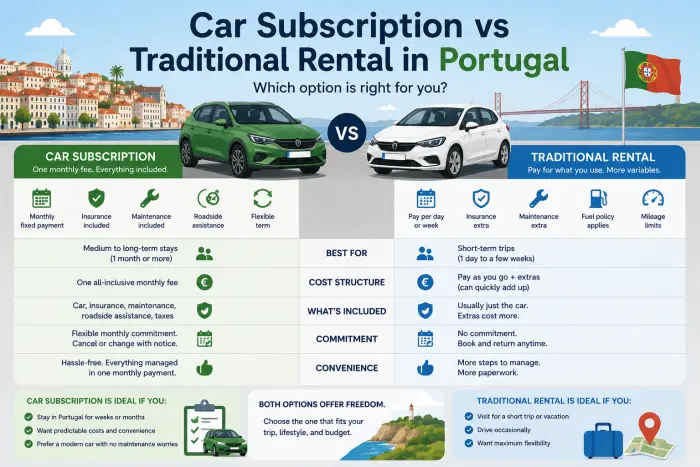
The essentials: traditional rental remains cheaper and simpler for trips under a month, with a huge selection of pickup locations including every airport. A subscription becomes competitive, and sometimes clearly better, for stays of two months or longer where flexibility and bundled costs matter more than the lowest possible daily rate.
How the Two Models Actually Differ
Traditional rental is built around a fixed-duration contract, agreed at booking, with a specific vehicle for a specific period, picked up and returned at a specific location, priced by the day or week. A subscription flips this structure: a recurring monthly fee bundles the vehicle, insurance, and often maintenance and roadside assistance into one payment, with the ability to cancel on relatively short notice, sometimes swap the vehicle itself partway through the membership, and no fixed end date baked into the initial agreement the way a rental contract has.
Pricing Structure Comparison
| Factor | Traditional Rental | Car Subscription |
|---|---|---|
| Billing structure | Daily or weekly rate | Fixed monthly fee |
| Insurance | Often optional add-on, varying coverage levels | Typically bundled into the monthly fee |
| Maintenance | Renter’s responsibility during rental period | Usually included in the subscription |
| Minimum commitment | Can be as short as one day | Usually a minimum of one month |
| Cancellation flexibility | Governed by the specific rate’s cancellation terms | Often more flexible mid-term than a fixed rental contract |
| Vehicle swap mid-term | Not available without a new booking | Sometimes available depending on provider |
Where Traditional Rental Still Wins Clearly
For anything under roughly a month, traditional rental remains the more straightforward and usually cheaper option, particularly for airport pickup and return, which subscription services generally don’t offer in the same way. If your trip is a standard holiday or short business visit with a defined start and end date, the daily-rate model, and the enormous supplier choice that comes with it including every major brand at Lisbon Airport, is built specifically for this use case and does it well. Comparing rates through a platform like Discovercars makes this even more straightforward for a standard trip. A subscription’s monthly minimum commitment and lack of airport-specific pickup infrastructure make it a poor fit for a short, conventional trip.
Where a Subscription Starts Making Sense
The calculation shifts for genuinely extended stays, a relocation, a multi-month work assignment, or an extended slow-travel period based in Portugal without a fixed return date. At this length, the bundled insurance and maintenance in a subscription’s monthly fee can work out simpler and occasionally cheaper than repeatedly renewing or rebooking a traditional rental, and the ability to cancel with relatively short notice suits a genuinely open-ended stay better than a rental contract that assumes a known end date from the outset. Our guide on long-term car rental in Portugal covers the traditional-model alternative for extended stays, which is still worth comparing directly against a subscription rather than assuming the newer model automatically wins for longer trips.
The Flexibility Trade-Off Worth Understanding
A subscription’s headline appeal, the ability to cancel or swap vehicles without the rigid structure of a rental contract, comes with its own less obvious constraint: subscription providers in Portugal have a considerably smaller footprint of pickup and return locations than the traditional rental market, concentrated mainly around Lisbon and a handful of other major cities rather than the wide network of airport and city desks traditional suppliers operate. If your stay involves moving between regions or picking up specifically at an airport, this geographic limitation is worth checking before assuming a subscription’s flexibility extends to location as well as duration.
Does a Subscription Make Sense for a Visitor Without Portuguese Residency?
This varies by provider and is worth confirming directly rather than assuming either way. Some subscription services in Portugal are built primarily around residents with a local address and banking setup, which can complicate signup for a visitor without either. Others are more accommodating of international customers on an extended stay, particularly ones targeting the digital nomad and remote-work market that’s grown in Portugal. Checking a specific provider’s residency and documentation requirements before assuming a subscription is accessible to a non-resident visitor avoids discovering a hard blocker partway through the signup process. This documentation scrutiny is generally more thorough than a standard airport rental, which typically only requires a valid licence and, for younger drivers, may involve a separate surcharge our young driver surcharge at Lisbon Airport guide covers in more detail.
Insurance Coverage: What’s Actually Bundled
It’s worth reading a subscription’s bundled insurance terms as carefully as you would a traditional rental’s coverage options, rather than assuming “included” means comprehensive by default. Some subscriptions bundle a baseline coverage level with a real excess still applying in the event of damage, similar in structure to a traditional rental’s default coverage, while others offer a more comprehensive zero-excess tier at a higher monthly price. See our guide on Portugal car rental insurance explained for the baseline concepts that apply to reading either model’s coverage terms critically.
💸 Don’t Overpay at the Airport
Compare real-time rental deals with no hidden fees or credit card needed.
How Subscriptions Differ From a Car Lease
It’s worth distinguishing a subscription from a traditional car lease, since the two get conflated occasionally despite being genuinely different commitments. A lease typically requires a longer minimum term, often a year or more, with a fixed vehicle for the duration and penalties for early termination that can be substantial. A subscription’s shorter minimum commitment and easier exit terms make it a meaningfully lower-risk option for someone uncertain how long they’ll actually need a car in Portugal, even though the ongoing monthly cost of a subscription is often somewhat higher than an equivalent lease payment, reflecting the premium paid for that added flexibility.
What Happens If You Need to End a Subscription Early
Exit terms vary meaningfully between providers and are worth checking before signing up, not after deciding to cancel. Most subscription services build in some notice period, commonly 30 days, before a cancellation takes effect, during which the monthly fee continues to apply. This is generally more forgiving than breaking a traditional long-term rental contract early, which can carry a larger one-time penalty, but it’s not instantaneous or entirely without cost the way the marketing language around “cancel anytime” sometimes implies. Reading the specific notice period and any early-exit fee before committing avoids an unwelcome surprise if your plans change faster than expected.
📋 Subscription vs Traditional Rental Checklist for Portugal
- Default to traditional rental for anything under a month, especially with airport pickup involved
- Consider a subscription specifically for open-ended or multi-month stays where flexibility matters more than the lowest daily rate
- Check a subscription provider’s specific pickup locations before assuming airport or multi-region access
- Confirm residency and documentation requirements if you’re a non-resident visitor considering a subscription
- Read the bundled insurance excess level carefully rather than assuming “included” means comprehensive
❓ Frequently Asked Questions
Is a car subscription cheaper than traditional rental in Portugal? It depends on trip length. For under a month, traditional rental is usually cheaper and more practical. For multi-month stays, a subscription’s bundled costs can work out comparably priced or better, factoring in the flexibility it offers.
Can I pick up a car subscription vehicle at Lisbon Airport? Generally no, or only at limited locations. Subscription services in Portugal typically have a much smaller pickup network than traditional rental, concentrated around major cities rather than airports specifically.
Do car subscriptions in Portugal include insurance? Usually yes, bundled into the monthly fee, though coverage levels vary. Some include a real excess similar to a standard rental, while others offer a more comprehensive zero-excess tier at a higher price.
Can a visitor without Portuguese residency sign up for a car subscription? It depends on the specific provider. Some are built primarily for residents, while others accommodate international customers on extended stays, so checking documentation requirements directly is worth doing before assuming either way.
Is a car subscription the same as a car lease in Portugal? No. A lease typically requires a longer minimum term with substantial early-termination penalties, while a subscription offers shorter commitment and easier exit terms, usually at a somewhat higher ongoing monthly cost.
Can I cancel a car subscription immediately if my plans change? Rarely instantly. Most providers require a notice period, commonly around 30 days, during which the monthly fee still applies, so it’s worth reading the exact exit terms before signing up.
For standard trips where traditional rental remains the clear choice, this comparison is worth revisiting each time your Portugal travel plans shift between a short holiday and a longer stay, since the better option genuinely depends on duration rather than personal preference alone.